The Handoff
I was alone in the cockpit, flying myself through a line of thunderstorms, when I realized I was trusting a complete stranger with something incredibly important.
I’d never met them. I probably never will. Yet for the next twenty minutes, I trusted them completely.
That realization changed the way I think about trust.
“November Six Two Three Mike Alpha, up to twenty degrees right turn approved. Advise when able to resume own navigation.”
I read the clearance back and banked the airplane to the right.
The weather display in front of me painted thunderstorms in red and yellow, their tops climbing well above my altitude. Outside the window, through occasional gaps in the clouds, I could see towering storm cells catching the afternoon sun. Beautiful to look at. Also the reason I was turning.
I was flying myself to Florida on an IFR flight plan, navigating around weather that was still building. Even with weather radar, GPS, moving maps, and every piece of technology available in the cockpit, I only had part of the picture.
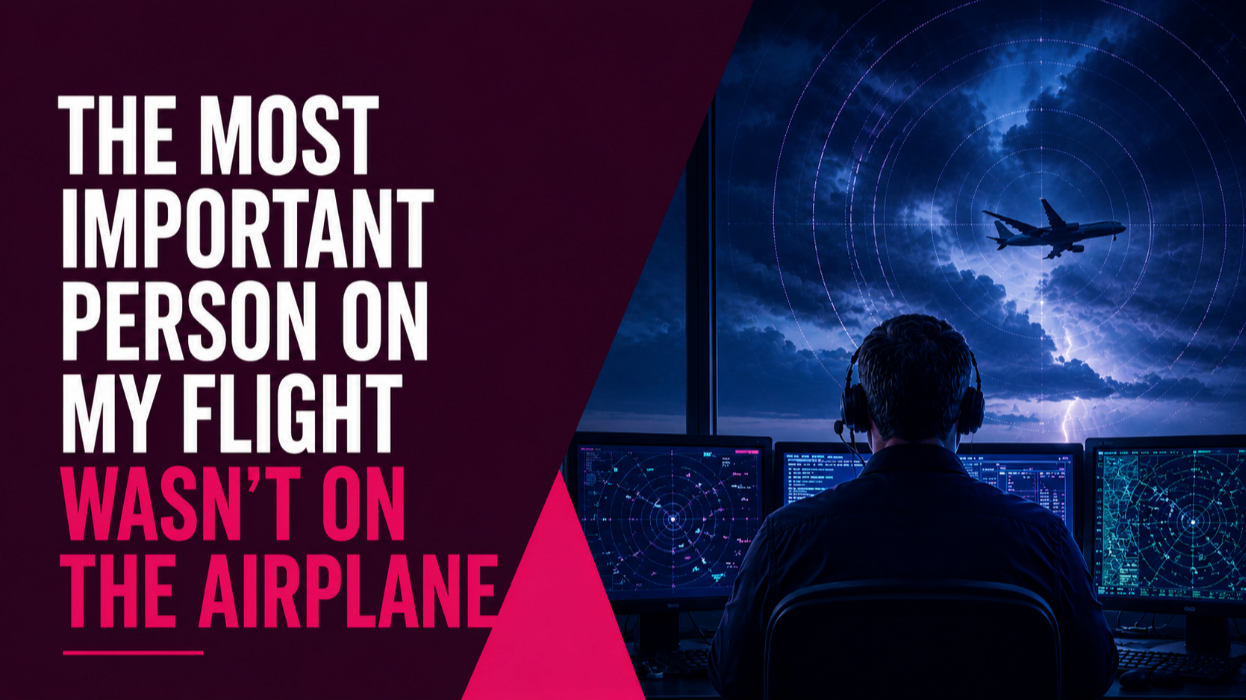
The controller had the whole picture.
Their radar wasn’t just tracking me. It was tracking every aircraft in the sector, weaving dozens of airplanes through changing weather while keeping each safely separated.
From my seat, I could only see my flight. From theirs, they could see the system.
Somewhere along that flight, I stopped thinking of the radio calls as instructions and started recognizing what they really represented.
I had handed over my place in the sky.
Not the yoke. Not the throttle. But my confidence that another aircraft wasn’t occupying the same piece of airspace. For that moment, that responsibility belonged to a voice on the radio.
The remarkable part isn’t that pilots trust air traffic controllers. It’s why. I don’t know the controller’s name. They don’t know mine. Within twenty minutes another controller takes over. Then another after that. By the end of a typical flight, I’ve trusted several complete strangers with something incredibly important.
Yet it works—tens of thousands of times every day. Not because we trust each other personally.
Because we trust the system.
Every transmission follows a common language. Every altitude means the same thing on every radar screen. Every clearance has one interpretation. Every readback confirms that both people understand exactly the same thing.
The procedures don’t change because someone is experienced, tired, confident, or having a bad day. Everyone agrees ahead of time what things mean.
That’s what makes trust possible at scale.
I think about that every time I watch a cybersecurity team respond to an incident.
It’s two in the morning. PagerDuty goes off. An engineer joins the bridge. Someone says:
“One of the admins got phished. Local admin credentials were compromised. Tools were dropped. Credential hashes were dumped. Exfiltration was blocked. The machine’s isolated. We’re still checking for lateral movement.”
The response comes back immediately.
“Understood. I’ve got it. I’ll be on the bridge in a few.”
To someone outside cybersecurity, that’s almost another language. To the incident response team, it’s remarkably precise. They know exactly what happened. What still needs to happen. Who owns which decisions. Where the uncertainty is.
The tooling matters. The automation matters. But underneath all of it is the thing that allows a team to respond at the speed an incident demands.
A shared language.
Rules that hold even while the details are changing. A common understanding of what the instruments are telling everyone.
We often talk about trust as something that’s earned one relationship at a time. And sometimes it is. But the trust that allows organizations to move quickly under pressure is different. It’s structural. It’s built long before the crisis arrives. It’s the discipline of agreeing—in advance—what “critical” means. What success looks like. Who owns which decisions. What every dashboard, alert, and status actually represents.
When those definitions are clear, strangers can pick up where someone else left off without missing a beat.
That’s exactly what happens every day in the national airspace system. And it’s exactly what high-performing security teams do during an incident.
So here’s the question.
If your best engineer stepped away in the middle of an incident tonight…
Would someone else know exactly where to take over?
Would “critical” mean the same thing to everyone on the bridge?
Would your dashboards tell the same story to your analyst, your executive team, and your client?
If not, that’s the gap.
Close it before you need it. Build the language. Strengthen the system.
Because when the pressure is highest, the quality of your handoff determines the quality of your response.
Frequently Asked Questions
It’s trust built into a system through shared definitions, terminology, and protocols agreed upon in advance. For audit and GRC teams, this means anyone reviewing controls or responding to a finding can pick up where another left off without confusion.
It lets teams convey complex, time-sensitive information precisely—so everyone knows what happened, what’s next, and who owns which decisions, without wasting time on clarification.
Define in advance what terms like “critical” or “high-risk” mean, what each dashboard/report represents, and who owns which remediation decisions—so any team member can step into an incident or audit response mid-stream.