The Real Talk:
- Why Microsoft tops the phishing impersonation charts at 22%—and how your brain’s own brand recognition is the vulnerability attackers are exploiting
- The $800 tool that tricks 60% of victims into hacking themselves by making legitimate websites look broken and offering a helpful “fix” button
- Apple’s upcoming AI-powered wearable pin has two cameras and three microphones—and your acceptable use policies definitely aren’t ready for it
A Closer Look:
The Brands Your Brain Trusts Too Much The crew breaks down the most spoofed brands in phishing—and the list reads like a who’s who of your daily digital life. Microsoft leads at 22%, followed by the usual suspects: Amazon, Google, and a holiday-season spike from DHL. The real insight? Your familiarity is the attack vector. As Nick Mellem points out, your brain auto-corrects misspelled brand names before you even register them. You already know Amazon. You already know Microsoft. So when a phishing email arrives with a subtle typo, your brain fills in the gap and your finger hits the link. That’s not a technology failure—it’s a wetware exploit.
ClickFix: The $800 Self-Hack Kit Eric Brown, CISSP brings a sobering breakdown of ClickFix, a technique gaining serious traction across industries. The attack makes legitimate websites appear broken—corrupted text, visual glitches—then presents a friendly “fix” button with instructions to paste code into your command prompt. The brilliance (and the horror): it bypasses security software entirely because your browser sees copying text and your antivirus sees you opening a command prompt. Both are normal activities. The malware then harvests credentials to web servers you manage, installs itself on those servers, and the infection cycle self-replicates. All for $800 out of the box. As Jennifer Lotze notes, when you can buy a phishing campaign for $25 and a self-spreading malware kit for $800, the barrier to entry for cybercrime has essentially collapsed. You don’t need an HR department to run a criminal enterprise anymore—you just need a credit card.
Apple’s AI Pin and the Privacy Reckoning Jen flags a 9to5Mac report on Apple’s upcoming AI-powered wearable pin—a thin disc with two cameras, three microphones, and enough ambient intelligence to make privacy advocates lose sleep. The security implications cascade quickly: consent for recording, data storage and access, criminal evidence questions, and the uncomfortable reality that Apple has outsourced significant AI capabilities to Google. The same Apple that built its brand on a closed, secure ecosystem is now partnering with Alphabet—and that changes the data trust equation entirely. Eric’s prediction? Within five to ten years, ubiquitous recording will be as normal as wearing a wristwatch. The question isn’t whether to resist it—it’s whether your policies, culture, and governance frameworks are ready for a world where everything is captured, all the time.
The Extrovert Security Engineer A live viewer question sparks one of the episode’s best moments: cybersecurity professionals need to be extroverts. Nick’s approach? Instead of remoting into machines from a back room, walk out to the factory floor. Fix the problem in person. Build the relationship so that when something suspicious lands in someone’s inbox, their first instinct is to call you—not click the link. Jen reinforces the point: IT is known as “the place of no.” The antidote is leading with the why, connecting security to protecting families and personal data, and building a culture where people understand that security serves them rather than restricts them.
Bottom Line:
The tools of cybercrime are getting cheaper, the attack surfaces are getting wider, and the line between your personal data and your professional exposure is getting thinner by the quarter. But the fundamentals haven’t changed: train your people, normalize security conversations, and stop letting your technical teams hide in back rooms. The organizations that treat security as a culture rather than a checklist are the ones that won’t end up as the next cautionary headline.
Tune into the full episode to hear about the $75 EMF Faraday beanie that started the whole conversation, Jen’s harrowing story of a $116,000 title company scam, and why Nick thinks the modern tinfoil hat deserves a line item in your IT budget.
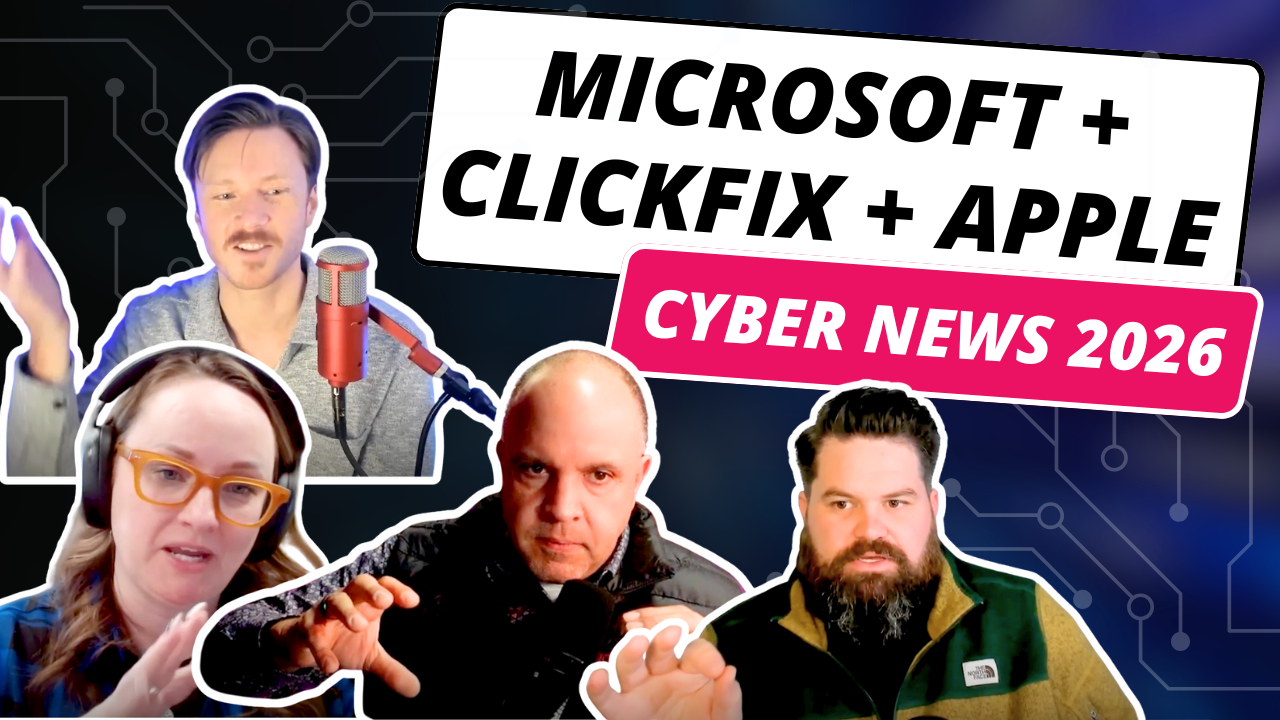
🔗 Ep 81 – Phishing’s Biggest Targets, ClickFix Malware & Apple’s AI Wearable
Listen wherever you get your podcasts – Subscribe to our YouTube channel to stay up to date on breaking cybersecurity news.
Learn more at www.itauditlabs.com