For many organizations, hiring a Managed Service Provider (MSP) feels like checking the “security” box. Servers are monitored. Updates are applied. Backups run on schedule. There’s a help desk when something breaks.
So it’s easy to assume cybersecurity is handled too.
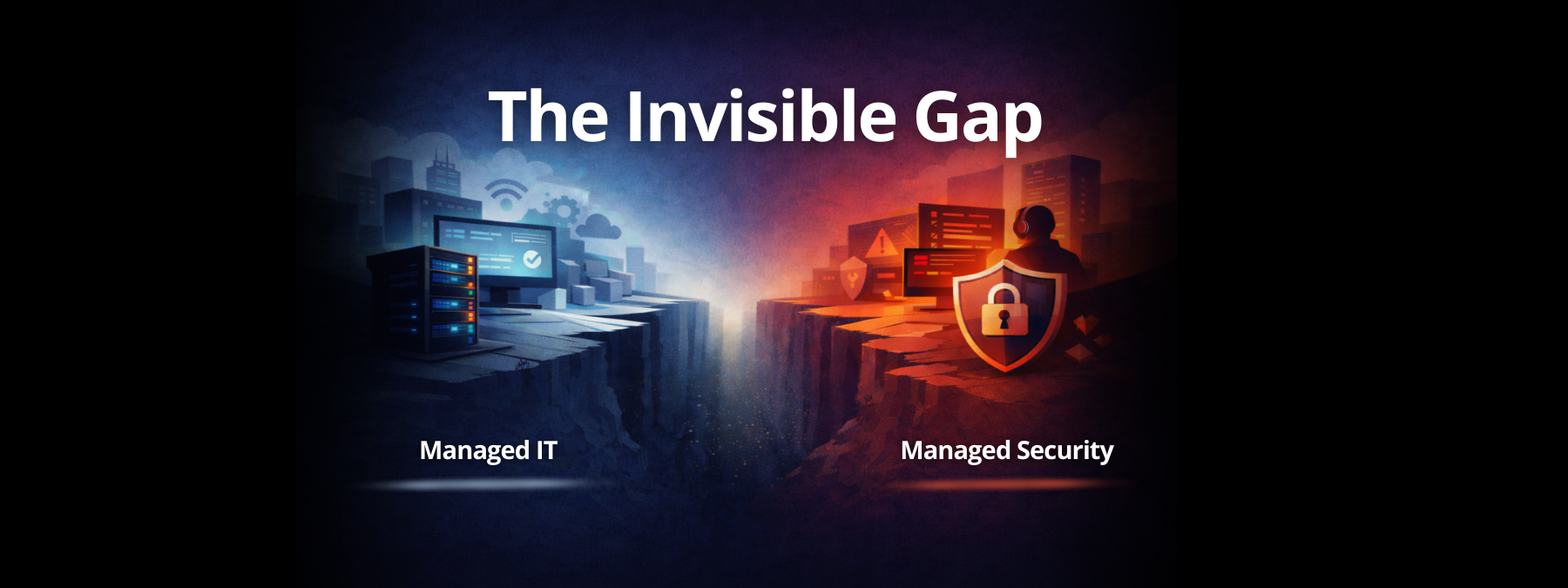
But here’s the uncomfortable truth: managed IT and managed security are not the same thing, and confusing the two creates dangerous gaps that attackers are more than happy to exploit.
This article explains where that assumption comes from, why it persists, and how to evaluate what your current agreement actually covers versus what requires specialized security expertise.
Executive Summary
Many organizations assume their managed IT provider also handles cybersecurity. In reality, managed IT focuses on system availability and user support, while managed security focuses on detecting threats, responding to incidents, and managing risk. This article explains the difference, highlights common MSP security gaps, and provides a framework for determining whether your organization has real security coverage or false confidence.
Where the Assumption Comes From
The confusion often starts with language.
Terms like monitoring, protection, firewalls, and threat prevention appear frequently in MSP service descriptions. To non-technical stakeholders, these terms sound like cybersecurity. In practice, they usually refer to operational stability rather than active threat defense.
Managed IT is designed to keep systems running smoothly by minimizing downtime, supporting users, and maintaining infrastructure. Managed security, by contrast, is built around identifying risk, detecting malicious activity, responding to incidents, and validating that security controls work as intended.
Both functions matter, but they solve fundamentally different problems.
What Managed IT Typically Covers and What It Often Doesn’t
Most traditional MSP agreements are built around uptime and support, not around defending against attackers.
Managed IT services commonly include system patching, endpoint maintenance, backups, network availability monitoring, and help desk support. Some providers also bundle basic antivirus or endpoint protection.
What is often missing is deeper security coverage. Continuous threat detection, centralized log analysis, investigation of suspicious behavior, identity misuse detection, cloud security posture monitoring, and meaningful risk assessments usually fall outside the scope of standard managed IT services.
These gaps often surface during an independent evaluation, which is why many organizations pursue a formal security risk assessment.
Why Security Requires a Different Skill Set
Cybersecurity is not simply an extension of IT. It is a distinct discipline with its own mindset, tools, and priorities.
Security teams operate under the assumption that systems will eventually fail, users will make mistakes, credentials will be compromised, and vulnerabilities will be exploited. That adversarial perspective drives practices such as continuous monitoring for abnormal behavior, structured incident response planning, forensic investigation, and alignment with regulatory and insurance requirements.
This is where dedicated security operations become essential. Services such as security operations center monitoring go beyond system alerts by actively investigating potential threats in real time.
The Hidden Risk of “Security by Checkbox”
One of the most dangerous outcomes of the MSP security assumption is false confidence.
Organizations often believe they are protected because a firewall exists, antivirus software is installed, backups are running, and someone is technically monitoring the environment. When a real incident occurs, they discover that no one was reviewing security logs, alerts were never tuned, response procedures were undefined, and there is no evidence to support compliance or cyber insurance claims.
This risk is amplified for organizations subject to regulatory or contractual obligations, where proving that security controls are working is just as important as having them in place. Many organizations address this through formal compliance and audit services.

Are You Assuming Security or Verifying It?
Many organizations don’t realize there’s a security gap until an incident, audit failure, or insurance renewal forces the issue. If your MSP agreement was designed around uptime and support, it may never have been intended to deliver real threat detection or response.
A neutral, third-party security risk assessment can help clarify what is actually being monitored, what risks exist today, and where responsibilities should be clearly defined — without requiring you to replace your existing IT provider.
How to Evaluate What You’re Actually Covered For
If you are unsure whether your MSP provides real security, start by asking direct questions.
Who is reviewing security alerts and how often? What triggers escalation? Who responds to a confirmed security incident and is that response included or billable? Are logs centrally collected and actively reviewed, and can you see evidence of that work? Has anyone assessed your real attack surface, including identity, cloud, and third-party risk?
If the answers are vague, inconsistent, or framed as best effort, security coverage may be assumed rather than delivered.
Where Managed Security Fits In
Managed security services are designed to complement managed IT, not replace it.
When responsibilities are clearly defined, IT teams can focus on keeping systems operational while security teams focus on detecting threats, responding to incidents, and reducing risk. Organizations that take this approach gain clearer accountability, better visibility into security activity, and fewer surprises during audits or incidents.
Why This Distinction Matters
Security assessments frequently reveal gaps between what organizations believe their MSP covers and what is actually monitored, tested, and defended. Independent evaluations help leadership teams understand real exposure, validate controls, and align security investments with reality rather than assumptions.
Closing the Gap Before It Becomes an Incident
Cybersecurity failures rarely happen because organizations ignored security altogether. They happen because organizations believed something was covered when it wasn’t.
Understanding the difference between managed IT and managed security is the first step toward closing that gap before attackers find it for you.
For organizations seeking an objective view of where MSP coverage ends and security exposure begins, an independent assessment can provide clarity without disrupting existing IT relationships. Learn more or contact IT Audit Labs to start the conversation.
Key Takeaways
- Managed IT focuses on uptime and user support, not threat defense.
- Managed security focuses on detection, response, and risk management.
- Many MSP agreements create security blind spots through assumed coverage.
- Asking the right questions exposes whether security is real or implied.
- Independent assessments help organizations close gaps before incidents occur.
Bottom Line
Managed IT keeps systems running. Managed security protects them from real threats. Confusing the two creates risk most organizations don’t discover until it’s too late.
FAQs
Is managed IT the same as managed security?
No. Managed IT focuses on system availability and support, while managed security focuses on detecting threats, responding to incidents, and managing risk.
Does my MSP provide cybersecurity monitoring?
Many MSPs monitor system health and uptime, but that does not always include security log analysis, threat investigation, or incident response.
What security gaps are common with MSPs?
Common gaps include limited visibility into security events, no defined incident response process, and lack of validation for compliance or insurance requirements.
When should an organization consider managed security services?
If you cannot clearly identify who would respond to a security incident or need to meet compliance or insurance requirements, managed security services may be necessary.
Can managed IT and managed security work together?
Yes. They are most effective when roles and responsibilities are clearly defined and complementary.
What is a security risk assessment?
A security risk assessment evaluates vulnerabilities and control gaps across an environment to help organizations prioritize improvements based on real-world risk.