Subscribe to The Audit Brief, where we break down the latest episode of The Audit Podcast.
This Episode:
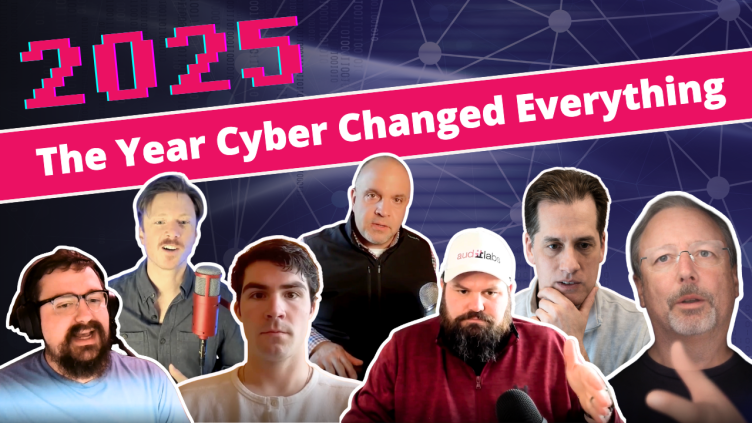
As 2025 draws to a close, Joshua Schmidt takes us on a journey through the year’s most thought-provoking conversations—the episodes that challenged assumptions and revealed just how rapidly cybersecurity is transforming. This isn’t your typical year-end recap. Instead, we revisit four pivotal moments with co-hosts Eric Brown, CISSP and Nick Mellem: a live deepfake demonstration that proved the threat is already here, a mind-bending exploration of quantum computing and parallel universes, a urgent wake-up call about AI governance gaps, and a celebration of community-powered security innovation. These clips represent more than highlights—they’re proof that in cybersecurity, standing still means falling behind.
The Real Talk:
- Why deepfake job interviews are no longer a future threat—they’re happening right now, and the tools are shockingly accessible (we’re talking minutes, not hours)
- The quantum computing revelation that made NASA shut down their quantum computer mid-experiment—and why parallel universes aren’t just science fiction anymore
- How most companies are racing to adopt AI faster than they’re thinking about security, and why the iPad infiltration of 2010 is repeating itself at 10x speed
A Closer Look:
The Deepfake Workforce Is Already Here Justin Marciano and Paul Vann from Validia didn’t just talk about deepfake threats—they demonstrated them live during our conversation. Using tools like Pickle and DeepLiveCam (both readily available), they showed how easy it is to create convincing fake identities for video calls. The implications? National security threats, IP theft, and entire industries vulnerable to infiltration. When someone can become anyone in minutes using free or low-cost tools, your video interview might not be interviewing who you think it is.
Quantum Computing Just Got Weird Bill Harris, CISSP took us down a rabbit hole that connects quantum computing to parallel universes. Google uncovered unexpected quantum results that they believe support parallel universe theory—and published it openly. Even stranger: NASA shut down their quantum computer in February 2024 after getting results that “challenge contemporary thinking.” No further comment. The theories range from new mathematics to alternate realities to extraterrestrial intelligence. Whether you buy into the Mandela Effect or not, one thing’s clear: quantum computing is revealing aspects of reality we don’t yet understand—and that has serious implications for encryption and security.
The AI Governance Wake-Up Call You’re Ignoring Alex Bratton ᯅ of Lextech delivered the uncomfortable truth most executives don’t want to hear: your employees are already using AI, whether you have policies or not. Remember when iPads invaded enterprises before IT could secure them? It’s happening again with ChatGPT, Claude, and countless other AI tools—but 10 times faster. The solution isn’t locking everything down (that just drives shadow IT underground). It’s about empowering employees with AI superpowers while drawing thin, strategic lines through your data and systems. If you haven’t stood up an AI governance board yet, you’re already behind.
Community-Powered Security Works Our conversation with Daniel Schaper and Adam Warner about Pi-hole proved something important: open-source security communities can deliver enterprise-grade protection at fractions of the cost. The Pi-hole community maintains daily-updated blocklists that rival commercial solutions. It’s a reminder that some of the best security innovations don’t come from vendors—they come from people who care enough to build and share freely.
Bottom Line:
2025 proved that cybersecurity isn’t just evolving—it’s fundamentally transforming. Deepfakes are trivially easy to create. Quantum computing is revealing realities we don’t understand. AI adoption is outpacing AI governance. The organizations that win in 2026 won’t be the ones with the biggest budgets—they’ll be the ones who adapt fastest while maintaining security fundamentals. Standing still means falling behind.
Tune into the full episode to hear the actual deepfake demonstrations, Bill’s deep dive into quantum memories and infinite parallel yous, Alex’s framework for responsible AI adoption, and why the Pi-hole community represents the best of open-source security collaboration.
🔗 Ep 79 – 2025 Year in Review: The Conversations That Changed How We Think About Cybersecurity
Listen wherever you get your podcasts – Subscribe to our YouTube channel to stay up to date on breaking cybersecurity news.
Learn more at www.itauditlabs.com